
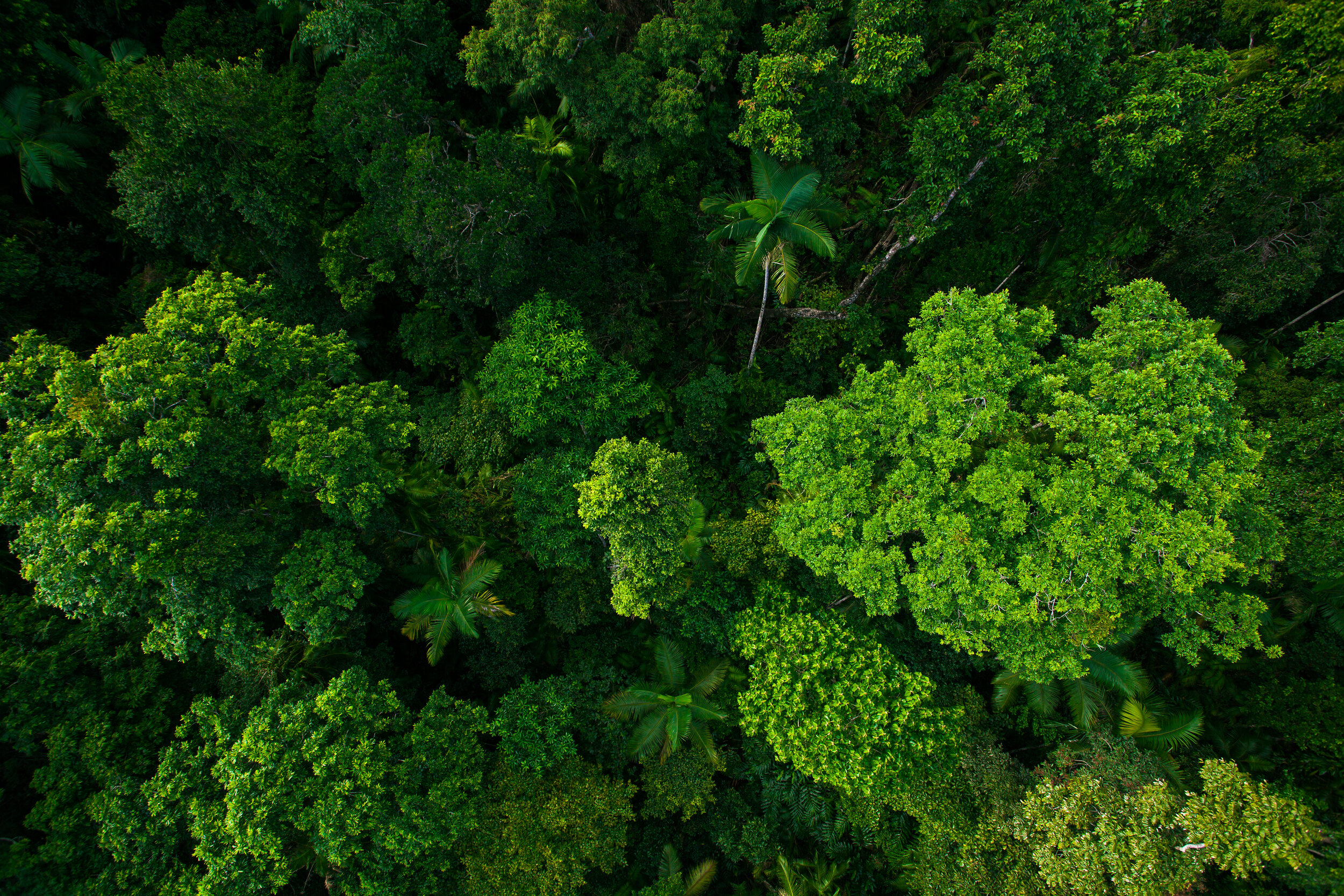
Soundscape Baselines Project
Scientific publications
For full list of publications from the lab, please see Google Scholar.

Large circles: Soundscape Baselines Locations, blue circles: other soundscape recordings
Soundscape Baselines Project
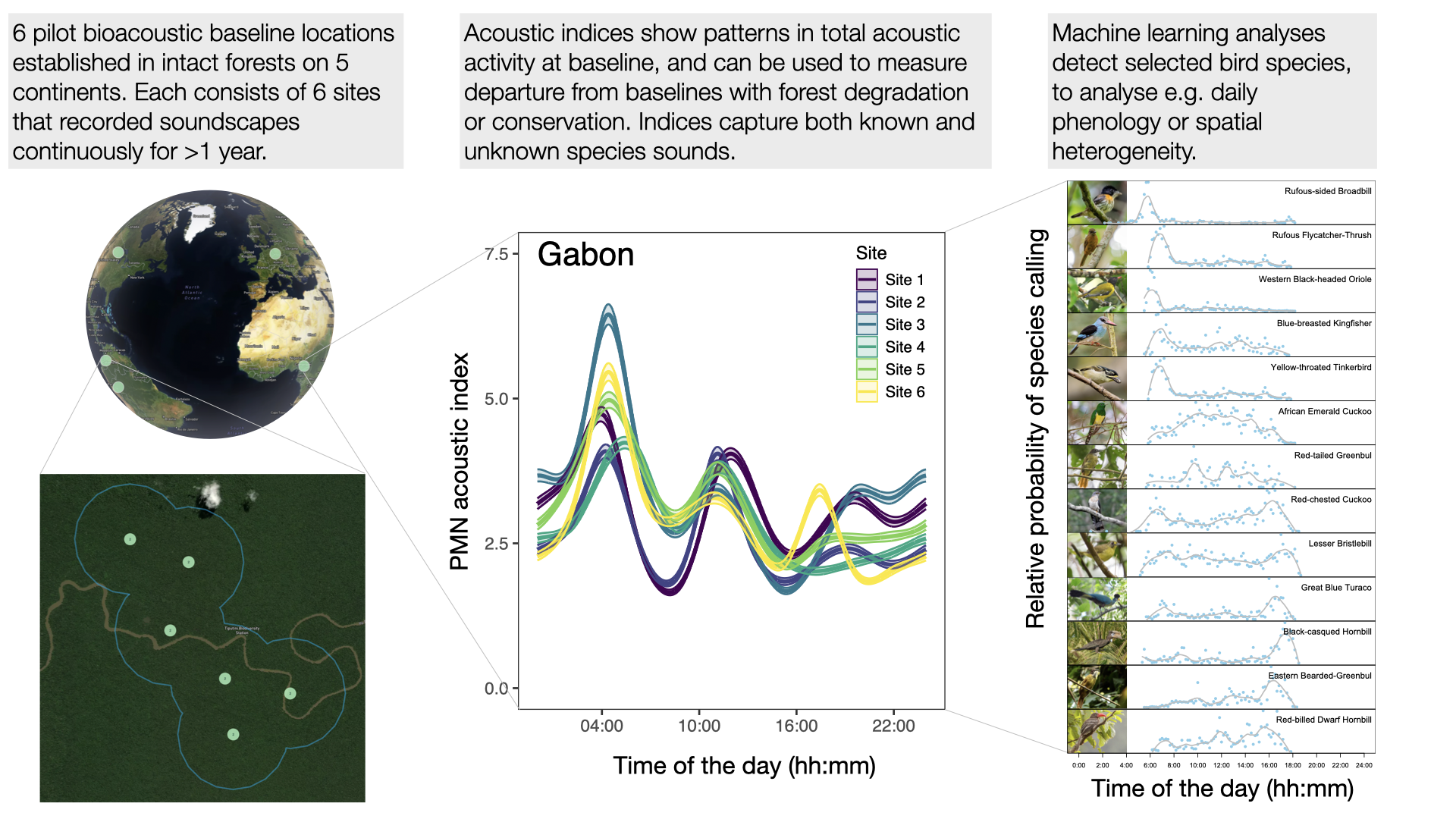
How could bioacoustic baselines be used in conservation?
In this introductory paper in Global Change Biology, we introduce and describe the Soundscape Baselines Project. We showcase four illustrative analyses using the collected data, including characterizing a bioacoustic baseline in terms of daily patterns in the soundscape, comparing baseline soundscapes to those from forests managed for timber, evaluating bird species composition at different altitudes, and looking into the daily patterns of vocalization of selected bird species. In the paper, we also propose where the next bioacoustic baselines can be established, based on forest intactness and global representation.
Citation: Z. Buřivalová, S. Perea, L. M. Berman, H. S. S. C. Sagar, T. M. Maeda, N. Yoh, G. Ingram, M. Persche, C. Mere-Roncal, A. Lopera-Toro, E. Chaboteaux, R. Rumelt, P. Alonso-Alonso, W. Mbamy, S. Ekazama Koto, G. Z. L. Froese, U. Grafe, H. H. Ahmad Sah, N. Zapata, G. Rivas-Torres, C. Wirth, C. Valle-Piñuela, I. J. Moreno-Buitrón, F. Macanilla, L. Ganchozo, J. Macanilla, R. Sanmiguel, D. Luther, A. Calhoun, E. Game, J. Schlüter, J. Müller, 2026. Bioacoustic Baselines for Intact Forests. Global Change Biology, 32:5.
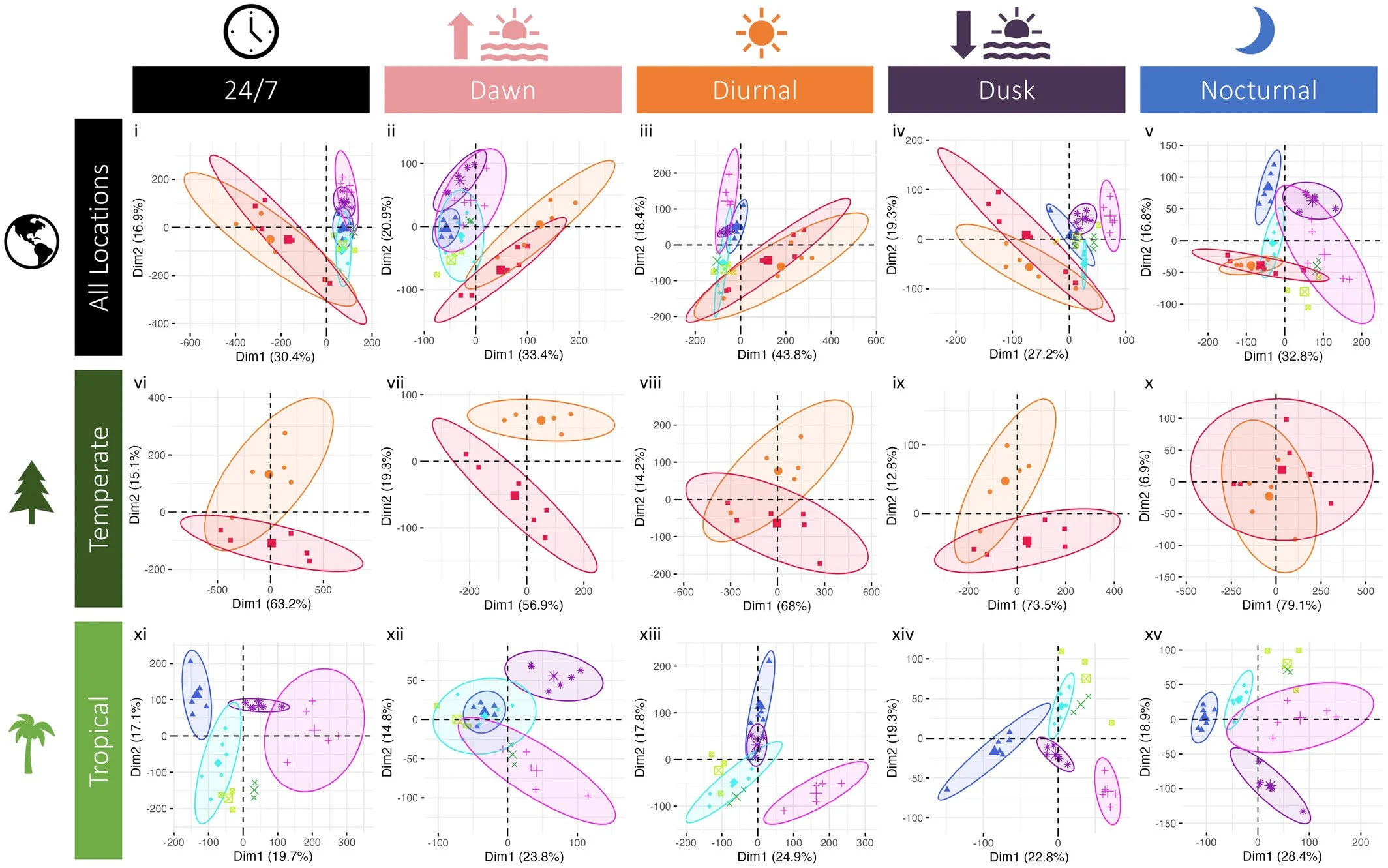
How do tropical and temperate intact forest soundscapes differ?
In this paper, we looked at the full soundscape - birds, insects, frogs, mammals, as well as environmental sounds like wind and rain - to determine whether each baseline forest has a distinct sound signature. We found that biogeographically closer sites have more similar soundscapes, and that you can distinguish between forests based on their soundscapes. This might not come as a surprise, but it is an important confirmation of the potential that soundscapes have in conservation monitoring.
Citation: Berman, L. M., Perea, S., Sagar, H. S. C., Persche, M., Ingram, G., Maeda, T., Natalie Yoh, Müller, J., Schlüter, J., Zapata, N., Wirth, C., Rivas-Torres, G., Valle-Piñuela, C., Moreno-Buitrón, I.J., Ganchozo Intriago, L., Macanilla Grefa, F., Macanilla Grefa, J., Mere, C., Chaboteaux, E., Lopera-Toro, A., Edwards, F., Mbamy, W., Ekazama Koto, S., Z. L. Froese, G., Rheindt, F.E, Grafe, U., Ahmad Sah, H.H., & Buřivalová, Z. (2026). Acoustic Indices Reveal Fundamental Differences in Daily Phenology of Tropical and Temperate Forest Soundscapes. Global Ecology and Biogeography, 35(3), e70224.
Methods

You have continuous soundscape data. Now what?
In this paper in Methods in Ecology and Evolution, we propose a framework for characterizing and comparing time series of soundscape data. This method can be useful when you don’t have a particular species of interest, but want to know about the broader soundscape patterns. Is the soundscape going through regular daily cycles? Are these cycles disrupted or changing over time, e.g. with climate change? Are the temporal patterns in your soundscape similar between groups of sites?
Useful for: scientists analyzing continuous ecological data, such as acoustic indices
Code: available including sample dataset
Citation: Yoh, N., Haley, C.L., Burivalova, Z. 2024. Time series methods for the analysis of soundscapes and other cyclical ecological data. Methods in Ecology and Evolution, 15:1158-1176
You want to use machine learning but don’t have a good species’ call library:
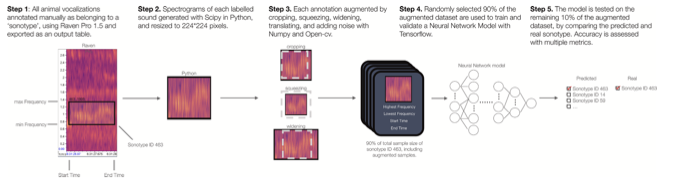
If you are looking to detect bird species calls, the first option to try might be BirdNET. But often we want to classify sound types, without necessarily knowing which species they belong to, because they might even be sounds by species not yet described by science in terms of their sound! Or, you might be needing to train your own model to recognize species specific to your study area. Check out our paper in Ecological Indicators about training a model on unique sound type, or ‘sonotypes’, using transfer learning and data augmentation. It also describes how you might build your own sonotypes library.
Useful for: scientists analyzing hyperdiverse soundscapes, such as from rainforests, where sound libraries are incomplete
Code: available including sample dataset
Citation: Sun, Y.m Maeda, T.M., Solis-Lemus, C., Pimentel-Alarcon, D., Burivalova, Z. Classification of animal sounds in a hyperdiverse rainforest using convolutional neural networks with data augmentation. Ecological Indicators, 145, 109621
Soundscapes to understand human impacts
Does carbon finance benefit biodiversity in Sierra Leone?
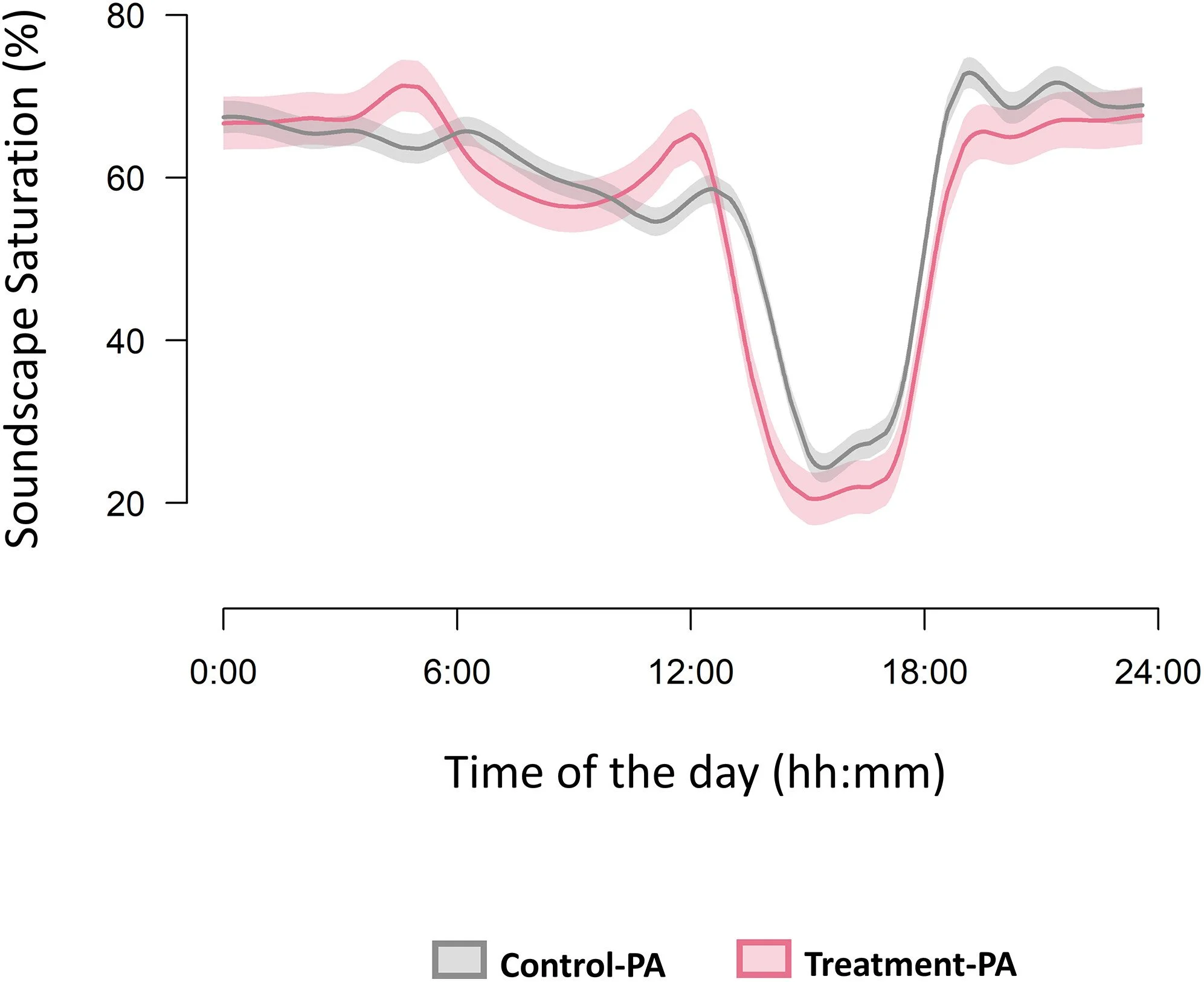
This paper lead by Sagara as a part of his PhD, and published in Conservation Science and Practice, we investigated whether a national park that also receives $$$ from the carbon finance initiative REDD+ conserves more biodiversity than a national park without such extra funding. To truly understand the effect of REDD+, and to rule out other potential factors, we used techniques from econometrics. We found that yes, the soundscapes of the national park with REDD+ finance are richer. In his other work, Sagara is investigating which species cause this difference, using both soundscapes and environmental DNA.
Useful for: national park agencies, conservation practitioners, government agencies deciding whether to encourage REDD+, carbon investors
Scientific innovations: using a study design that allowed us infer causation rather than correlation
Citation: Sagar, H. S. C., Raynor, J., Edwards, F. A., Sanderson, F. J., Jones, S., Yu, D. W., Bush, A. Persche, M.E., Bodasing, T., Taire, M.E., Gottesman, D., Feika, M.E., Nyallay, M. & Buřivalová, Z. (2026). Carbon finance initiatives can provide biodiversity benefits. Conservation Science and Practice, e70254.

How does forestry, protected areas, and hunting impact biodiversity in Gabon?
In this paper in Biological Conservation, covered by Mongabay, we tried to figure out whether FSC-certified sustainable forestry is better than regular forestry in terms of its biodiversity impact. Along the way, we realized that hunting is a big part of the story - so we used soundscapes not only to measure biodiversity, but also gunshots. We were also privileged to record and analyze soundscapes from a never-logged ancestral forest of the Massaha community. You can read about the story of Massaha’s conservation efforts on Mongabay.
Useful for: foresters, conservation practitioners, government agencies deciding whether to encourage certification
Scientific innovations: recording both biodiversity and threat with the same method, large-scale sampling, GAMMs use on acoustic indices
Citation: Yoh, N., Mbamy, W., Gottesman, B.,L., Froese, G.Z.L., Satchivi, T., Obiang Ebanega, M., Carlson, L., Ekamza Koto, S., Ozdogan, M., Seaman, D.J.I., Maicher, V., Malinowski, H., Poulsen, J., Mbele, A.E., Burivalova, Z. 2024. Impacts of logging, hunting, and conservation on vocalizing biodiversity in Gabon. Biological Conservation 296, 110726.
How does biodiversity recover with forest restoration in Ecuador?
In this paper in Nature Communications, we documented the recovery of vocalizing species, using bioacoustics and environmental DNA meta-barcoding, along a forest restoration gradient. This time, we used several different methods - acoustic indices, as well as machine learning - to analyze the soundscapes.
Useful for: conservation practitioners, restoration experts, funders of forest restoration initiatives
Scientific innovations: analyzing soundscapes using acoustic indices and machine learning, paired with eDNA meta-barcoding
Citation: Müller, J., Mitesser, O., Schaefer, H.M., Seibold, S., Busse, A., Kriegel, P., Rabl, D., Gelis, R., Arteaga, A., Freile, J., Leite, G.A., Nascimento de Melo, T., LeBien, J., Campos-Cerqueira, M., Blüthgen, N., Tremlett, C.J., Böttger, D., Feldhaar, H., Grella, N., Falconí-López, A., Donoso, D.A., Moriniere, J., & Burivalova, Z. 2023. Soundscapes and deep learning enable tracking biodiversity recovery in tropical forests. nature communications 14, 6191.

Underlying theories

Why do birds sing the way they do?
In this project, we looked at all the bird song recordings on xeno-canto, to understand the eco-evolutionary patterns of bird song. By using such an unprecedented size of a dataset, and some clever processing of the recordings, we were able to test major acoustic hypotheses, such as how body mass and beak size relate to the frequency at which a bird makes sounds, or whether the bandwidth of a bird’s song related to longitude.
Useful for: scientists interested in eco-evolutionary hypotheses
Scientific innovations: automatically processing huge amount of recordings from xeno-canto, using DAGs to test the hypotheses
Citation: H.S. Sathya Chandra Sagar, Anand, A., Persche, M.E., Pidgeon, A.M., Zuckerberg, B., Sekercioglu, C.H., Burivalova, Z. 2024. Global analysis of acoustic frequency characteristics in birds. Proceedings of the Royal Society B 291, 2034.