
Listen & watch
Every forest has a unique acoustic signature shaped by climate, geography, and animal communities. Explore soundscapes from forests participating in the Soundscape Baselines Project and beyond.
Illustrations by Sarah Heuzeroth, animals for illustrations selected by Soundscape Baselines Teams.

Borneo lowland rainforest, Brunei
Lowland dipterocarp forests in Brunei are among the most acoustically rich ecosystems on Earth. Giant rainforest trees support a dense community of vocalizing species at dawn, including Helmeted hornbills and gibbons, featured on the soundscape illustration by Sarah Heuzeroth. Learn more about the Brunei team or listen in:

Northwest Congolian lowland forest, Gabon
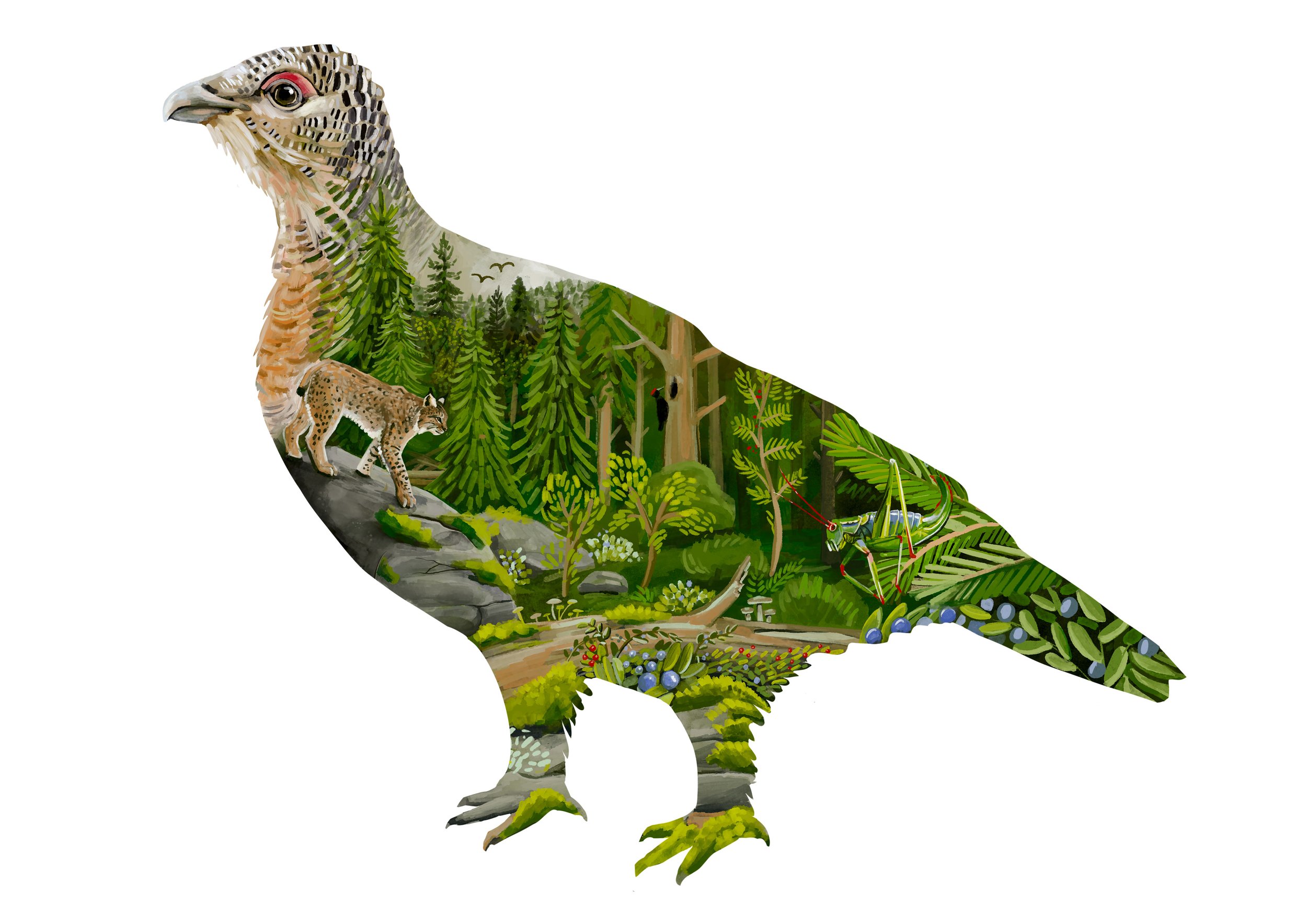
Western European broadleaf forest, Germany
The soundscape baselines forest sites in Germany include a mosaic of deciduous and mixed montane woodlands, with beech-dominated stands as well as conifers. At dawn in the spring, the landscape is filled with a layered chorus of thrushes, woodpeckers, and other forest birds, interwoven with subtle insect and mammal sounds that reflect the seasonal rhythm of these temperate forests. The illustration features a female of the Western capercaillie. Learn more about the German team and listen in:

Peruvian Yungas and Southwest Amazon, Peru
The transition between the Peruvian Yungas and Southwest Amazon moist forests spans an impressive elevational gradient from Andean foothill cloud forests into lowland Amazonian rainforest, creating a range of habitats and extreme bird species diversity. Dawn soundscapes in these forests are marked by a dense chorus of tanagers, antbirds, tinamous, insects, as well as primates, such as the woolly monkey, featured in the illustration. Learn more about Peru team and listen in:

Upper Midwest forest-savanna transition, USA
The forest–savanna transition zone of the Upper Midwest in Wisconsin is a mosaic of oak-dominated woodlands, open savannas, and early successional habitats shaped by fire, climate, and land use history, with pockets of old forests. At dusk, the soundscapes typically have the calls of frogs, chorus of birds settling for the night, and sometimes coyotes - featured in the illustration. Learn more about the Wisconsin team and listen in:
The Northwest Congolian lowland forests of Gabon are part of the largest remaining expanse of intact tropical rainforest in Africa - the Congo Basin. They have exceptionally high biodiversity, including gorillas, forest elephants, and Dwarf crocodiles (silhouette of the illustration). In the morning, the soundscapes often have the calls of hornbills, turacos, primates, insects. Learn more about the Gabon team and listen in:

Napo moist forests, Ecuador
The Napo moist forests of Ecuador lie within the western Amazon Basin and are recognized as some of the most biodiverse on Earth. The extraordinary concentrations of birds, amphibians, such as Osteocephalus planiceps, featured in the illustration, insects, and mammals, such as Howler monkeys, result in a complex, busy soundscape, that changes throughout the day. Learn more about Ecuador team and listen in: